A Banker's Garden

Tuesday, 18 July 2017

An Accomplished Odissi Danseuse Who Survived Cancer

I watch the classical dance programme telecast by DD Bharati in afternoons every day. Whenever i like a particular presentation, i note down the name of the artiste and later, i watch her/his dance numbers on You Tube and sometimes, find out more  about the dancer from Google. One day, in a programme produced by Door Darshan, Mumbai,  Subhada Varadkar was the danseuse. I very much liked her presentation.

Here is one:


Subhada first started learning Bharatnatyam. Then she learnt Odiss dance under the tutelage of the legendary Odissi dance Guru Kelu Charan Mohapatra of Odisha. She was amazed by the nuances and subtleness of Odissi dance. 
 
From Google i came to know that she had survived an attack of ovarian cancer! The following is extracts from this.

Source: Google - The Times of India


During a performance in London in November 2006, Shubhada began to feel uneasy. "I was bleeding but assumed it was a regular menstrual problem since there was no pain." She flew back to India the next day and underwent a sonography. Her doctors were surprised that she had danced with such a large tumour, not even complaining of pain. She was 40 at that time.

Subhada's grandfather, Dr V R Khanolkar was the first dean of Tata Memorial's Cancer Research Institute. 


Although she was not allowed to practice, she conceptualised her dance, lying in bed. 

The reports came and these showed that she had two tumours, one in the ovary and another in the uterus. Fortunately, both were in the primary stage.

In January 2007, she started chemotherapy. She would schedule performances keeping the chemotherapy and radiation sessions in mind. She used to lock the dates for performances three weeks after chemo, because, by then the blood count would be back to normal.

While undergoing weekday radiation sessions, she  used to perform on weekends.


She tried to bring in positive rhythms in her body and mind. "Cancer treatment isn't just about access to the best drugs or therapy. It's also about how positively your body responds to treatment. Your state of mind plays a huge role its cure," Subhada adds.

The four chemotherapy sessions she underwent between January and April 2007, left her vulnerable.

Being a dancer meant that she had to be physically fit and look presentable. She was losing her hair, and even her eyebrows. The medication made her hands and feet go numb. While dancing, balancing the mukoot on a wig with nothing to latch on was a challenge. Her mother crafted a special toupee that could be tied behind the ears.She was determined that she would dance and afraid that if the truth about her health became known, she might not get any performance.


Later, months after her last chemotherapy session and when she was recuperating, Subhada  stopped hiding her cancer-survivor status. In 2008, she met another cancer patient who was finding it hard to accept the truth. The impact she made on the other, encouraged her to take up awareness as a cause, especially among other artists. She spreads such awareness about the disease.


"Early in 2008, I met a fellow cancer patient who was having a hard time accepting the truth. I tried to motivate her by using myself as an example. The impact I was able to make on her encouraged me to take up awareness as a cause, especially for the artist community," she adds. With dance being her only language of mass communication, she now routinely gives performances to spread awareness about the disease, communicating that although the cancer-treatment is difficult, it is curable.

She has written a book titled 'Mayurpankh' narrating her struggle and ultimate triumph.


My post titled 'Goddess of Odissi Dance' dated 29.09.2012, is about the legendary Odissi danseuse Sanjukta Panigrahi of Odisha who made Odissi dance what it is today. When she was at the height of her dancing career, she was diagnosed with cancer and succumbed to it in 1997 at the age of 53.

Here is another of Subhada's dance recitals:


Posted by The Gardener at 08:37 No comments:
Labels: Culture, Life, Odissi dance

Sunday, 14 May 2017

Doubly Cursed


It happened at a small place in Puri District of Odisha.

It was an arranged marriage. As per tradition, the bride’s brother had come as bardhara to formally invite the groom to come to their house for the marriage. The groom was getting elegantly dressed up for the occasion for starting in the decked up vehicle for the marriage-procession. At that time, a minor electrical fault in the room was noticed. A person climbed up an wooden stool to rectify it. He asked the groom to help him and the groom readily agreed.

Then all hell broke loose. Accidentally, the groom had touched a live electric wire. The death was instantaneous. The bardhara had to go back, carrying the sad news.
As per tradition, mangalakrutya (the bride ritually and ceremonially being made to sit on a grinding stone, other married ladies applying haldi paste on her limbs and bathing her) had already been performed on the previous day. Also, she had been bathed in badua pani (traditional water) which had symbolized the imminent end of her unmarried life. Tradition dictates that a mangula kanya (a girl who has undergone the process of mangalakrutya) can no longer remain in the parental house; she has got to be married off, post haste. This is done by very quickly finding out a suitable groom (dubbed Dhara Bara - literally, a caught groom) and marrying her off to him.
The girl’s parents and relatives did locate a groom and the marriage took place. The bride moved to the new groom’s house.

After spending two days there (but before the nuptial with the boy), the girl, who was highly educated, found that the boy was only low-educated. She was not ready to suffer her whole life with this semi-literate person. She preferred to go back to her to her parents’ house even with the prospect of remaining a spinster throughout her life.

Fortunately for her, the boy let her go.

And she returned.

Many questions remain unanswered:

Will she remarry?

Legally, she is a married woman, although she had had no physical relation with her ‘husband’. If she decides to remarry, she has first, to be got divorced from her present ‘husband’.  

How will the society look upon her? 

As a brave woman? A challenger of fate?

A far-fetched simile comes to mind. Should she have continued to stay in the house of her ‘husband’ and force him, goad him, to be educated like the highly learned princess, Kalidas’s wife did? 

Would it have been possible? Is it possible to make a legend a real event in a real life?

It may be recalled that this princess was very well-conversant with the Shstras and stipulated the condition that she would agree to marry only a person who would defeat her in a debate. Many eligible and wise persons came seeking her hands but no one could defeat her in the debate, A few of such persons saw the foolish Kalidas cutting from the stem, a branch on which he was sitting. To teach the princess a lesson, they manipulated things and took Kalidas to her father. They told the King that Kalidas was a very learned man but was on a vow of silence; he would answer the princess’s questions only with gestures. During the debate, the princess mistook Kalidas’s gestures, took him to be a very learned person and thought that she had lost to him in the debate. So, she agreed to marry him. The marriage was solemnized. Soon after, she found out that he was actually a fool and was an unlettered man. So she asked him to leave. On the way back, Kalidas got the blessings of Saraswati, the goddess of learning, and became a really learned man. He went to her; she accepted him and they lived happily ever after.

POST SCRIPT, 20th May:

Subsequent reports say that the 'husband' whom the girl had left, got married to another girl soon after.
Posted by The Gardener at 17:23 2 comments:
Labels: Death, Life

Thursday, 13 April 2017

H B D - Bhubaneswar


Today, the 13th April, is the Birthday of the new capital of Odisha – Bhubaneswar. The foundation of the new city was laid on the 13th April, 1948 by the first Prime Minister of India – Jawaharlal Nehru.
The foundation-stone, located in front of the Odisha Legislative Assembly building, has the following legend:
It is my pride and pleasure and privilege today, the 13th April, 1948, to declare that the foundation-stone of the capital-city of Bhubaneswar has been well and truly laid. I dedicate this city to the wellbeing of the people of Orissa. Jai Hind. – Jawaharlal Nehru                                                                                                                           

Since ancient times, Cuttack was the capital of Odisha. The selection of the site for the new capital of Odisha (earlier Orissa) was a long-drawn process. In 1933, an administrative committee of the British Government had recommended building of the capital in Chauliaganj area of Cuttack. However, it was felt that since Cuttack has two flood-prone rivers, viz. Mahanadi and Kathajori, on both its sides, Cuttack was ruled out. After the separate language-based Province of Orissa was carved out on the 1st April, 1936, a Jones Committee was set up for finding a site for the capital of Orissa. This Committee considered Rangeilunda, located between Bramhapur and Gopalpur but another Committee ruled it out. Then one Dan Committee was set up for the purpose but this was abandoned. Subsequently, Chowdwar, Anugul and Khorha were considered but were found not suitable. Around Independence of India in 1947, the large and open wasteland between the old temple-town of Bhubaneswar (where the Lingaraj Temple and a host of other ancient temples are located) and Mancheshwar was finally selected. The then Prime Minister of Orissa (before Independence, chiefs of the Provinces were called ‘Prime Ministers’) preferred this site and it was approved by the Provincial Assembly. The environment, climate, natural beauty, historical heritage, and the scope for constructing roads and buildings in this area weighed in its favour.

The blueprint for the new capital was prepared by the German city-planner Otto Koenigsberger. It was planned in an area of 12 square miles for 40,000 people and 1500 buildings including Raj Bhawan, Assembly Secretariat, building for Heads of Departments, quarters of Ministers, MLAs and officials, offices of the Accountant General, the Post Master General, hospital, shops and markets etc.
The present population is touching 12 lakh.

The city started with a Special Planning Authority, which gave way to Bhubaneswar Regional Improvement Trust which in turn gave way to the present Bhubaneswar Development Authority.

To look after the area’s civic needs, a Notified Area Committee was established in 1948 when the population was 15,000. In 1952, it was upgraded to a Notified Area Council. This gave way to Bhubaneswar Municipality in 1979. As population increased, it was, in 2004, upgraded to Bhubaneswar Municipal Corporation and its Chairman was designated as Mayor.
   
When last year, Government of India launched the concept of Smart Cities, Bhubaneswar became one of them.

Bhubaneswar is considered a City of Temples. With the famous temple of Lord Jagannath at Puri and the ‘Black Pagoda’ Sun Temple at Konark, both about 60 Kms from Bhubaneswar, the trio is called ‘The Golden Triangle’.  
      

Posted by The Gardener at 12:54 No comments:
Labels: Heritage, Life

Saturday, 8 April 2017

Ravenshaw - My Alma Mater

Ravenshaw College (now University) where i got my college-education, is completing 150 years of its service and an year-long Sesquicentennial Celebration is on. A special cover has been issued by Govt. of India to mark the occasion. 


I studied in this College (as it was then) from 1964 to 1968. I have briefly referred to some events, permanently embedded in my mind, about my days there, in my post ‘Those Hard Days, That One Rupeeand A Sweet Tail’ dated 20.03.2013 . 

After the infamous famine of 1866, the intellectuals of Odisha and a few liberal Britishers thought of starting a college at Cuttack. Stung by the criticism of the ineptitude of the Administration in tackling the famine and probably due to the compunction felt by him for not having done much for prevention and handling the famine, T E Ravenshaw, the then Commissioner of Odisha Division, wished to do something for the region. Keeping in mind to use the unspent amount of the Famine Relief Fund, he convinced the Government of Bengal (At that time, Odisha was a part of Bengal Presidency.) about the difficulties of Odia students in getting College education. As a result, collegiate classes were started in the Cuttack Zilla School. Thus the first College in Odisha was born in January 1868. It started with Intermediate classes and six students on roll.

In January 1875, Ravenshaw proposed to convert the Collegiate School into a full-fledged degree College. The Government of Bengal stipulated a condition that a public contribution of Rs.30 thousand be deposited for the proposed College. H. J. Reynolds, the then Secretary to the Government of Bengal, requested the Government of India to sanction the incidental charges and the post of the Principal with the additional condition that half of the monthly expenses should be met by public donation.

The Collegiate School was converted in 1876 to a full-fledged Degree College, with the name ‘Cuttack College’. The Maharaja of the Princely State of Mayurbhanj Sri Krushna Chandra Bhanjdeo donated Rs. 25 thousand as a permanent endowment for the college. This almost fulfilled the condition stipulated by the Government for public contribution. As suggested by him, the name of the college was changed to Ravenshaw College in 1878, to commemorate his services to the cause of education in Odisha.
The college was shifted to its present site, with an area of 87 acres, in1921. Maharaja of Mayurbhanj donated Rs. 1 lakh for the electrification of the new building and purchase of equipment for science laboratories. Perhaps the Physics and Chemistry blocks bear the names ‘Mayurbhanj Physics Laboratory’ and ‘Mayurbhanj Chemistry Laboratory. Maharaja of Kanika, Sri Rajendra Narayan Bhanjadeo donated Rs. 55 thousand for the construction a library building. It was opened in 1922. In his honour, the library was named as Kanika Library. 

Post-Graduate classes, M.A. in English, started in 1922 with a donation of Rs. 1.71 lakh by Maharani Smt. Parvati Devi of Sonepur.

Co-education began in 1929-30 with 4 girls taking admission.

The College was originally affiliated to Calcutta University. When the Province of Bihar & Orissa was separated from Bengal, the College was affiliated to Patna University. It continued as such, even after the separation of Odisha from Bihar in 1936. A separate University called Utkal University for Odisha was created in 1943 and Raveshaw College was affiliated to it.  The University started functioning in the Zoology Department of Ravenshaw College. The law department of Ravenshaw College was separated and became Madhusudan Law College. Utkal University functioned at Ravenshaw College for 20 years and was shifted to its new campus at Bhubaneswar only in January 1963.

When Odisha became a separate State on the 1st April 1936, its Legislative Assembly started functioning in the Examination Hall of Ravenshaw College. Because of this, it was called the Assembly Hall. It continued to be called so, long after the State Capital was shifted from Cuttack to Bhubaneswar in 1948 and the Assembly started functioning in the new building at Bhubaneswar. It was being called so during 1964-68, when i was a student of the College. This hall has since been re-christened as Heritage Hall. 

Ravenshaw College was the vortex of political, intellectual and literary movements in Odisha for a long period. It has produced many intellectuals, poets, politicians, judges and bureaucrats.

History of Raveshaw College is the history of Odisha. All the significant cultural, intellectual and political movements of the state have started in its campus.  It produced great people like Utkal Gourab Madhusudan Das, Utkalmani Gopabandhu Dash. Acharya Harihar Das, Pandit Nilakanth Das, Pandit Godabarish Mishra, Bhubananda Das and many others. So much so that the Intelligence Department of the British Government of India used to keep a close watch on its students during the Indian freedom movement. Bibhudendu Mishra was the leader of the students who removed the British Flag Union Jack from top of the College building and hoisted the tri-colour flag which later gave birth to the Indian National Flag.

Netaji Subhash Chandra Bose, born in Cuttack, was a student of the College. Before him, his father Janakinath Bose also had studied here. 

It had on its staff such great scholars as Artaballav Mohanty, Sir Jadunath Sarkar, Sir Ross Masood, Prana Krushna Parija and Balabhadra Prasad. The first Odia Principal and later Director of Public Instruction, Shyama Charan Tripathy, who later was appointed as a member of the Federal Public Service Commission (renamed as Union Public Service Commission), was a product of this college. 

Most of the prominent political leaders of the state such as Biswanath Das, H.K.Mahatab, Nityananda Kanungo, S.N.Dwibedi, Biju Patnaik, Janaki Ballav Patnaik and former Speaker of Lok Sabha Rabi Ray were Ravenshavians. 

The College produced great creative writers like Kalindi Charan Panigrahi, Ananda Shankar Ray, Gopinath Mohanty, Sachidananda Routray, Surendranath Mohanty and Mayadhar Mansingh. Jnanapith Award winners Gopinath Mohanty, Sitakant Mohapatra and Prativa Roy, the well-known poet Jayanta Mohapatra and the feminist writer Sarojini Sahu were students of this College. The famous historian Ramesh Chandra Majumdar studied here. So did former Chief Justice of India Ranganath Mishra and Lalitendu Mansingh,  former Foreign Secretary and Indian Ambassador to U S A.

The Odisha State Museum at Bhubaneswar first started functioning from Ravenshaw College.  


Guruji Chandrabhanu Satapathy, known for his spirituality all over India and outside, was my classmate at Ravenshaw College for 4 years. 

Till the end of the 20th Century, the answer to the question about who a famous person of Odisha was, “He/she was a Ravenshavian.” During my student-days at this College, i used to hear that anybody who is somebody in Odisha, was a Ravenshavian.
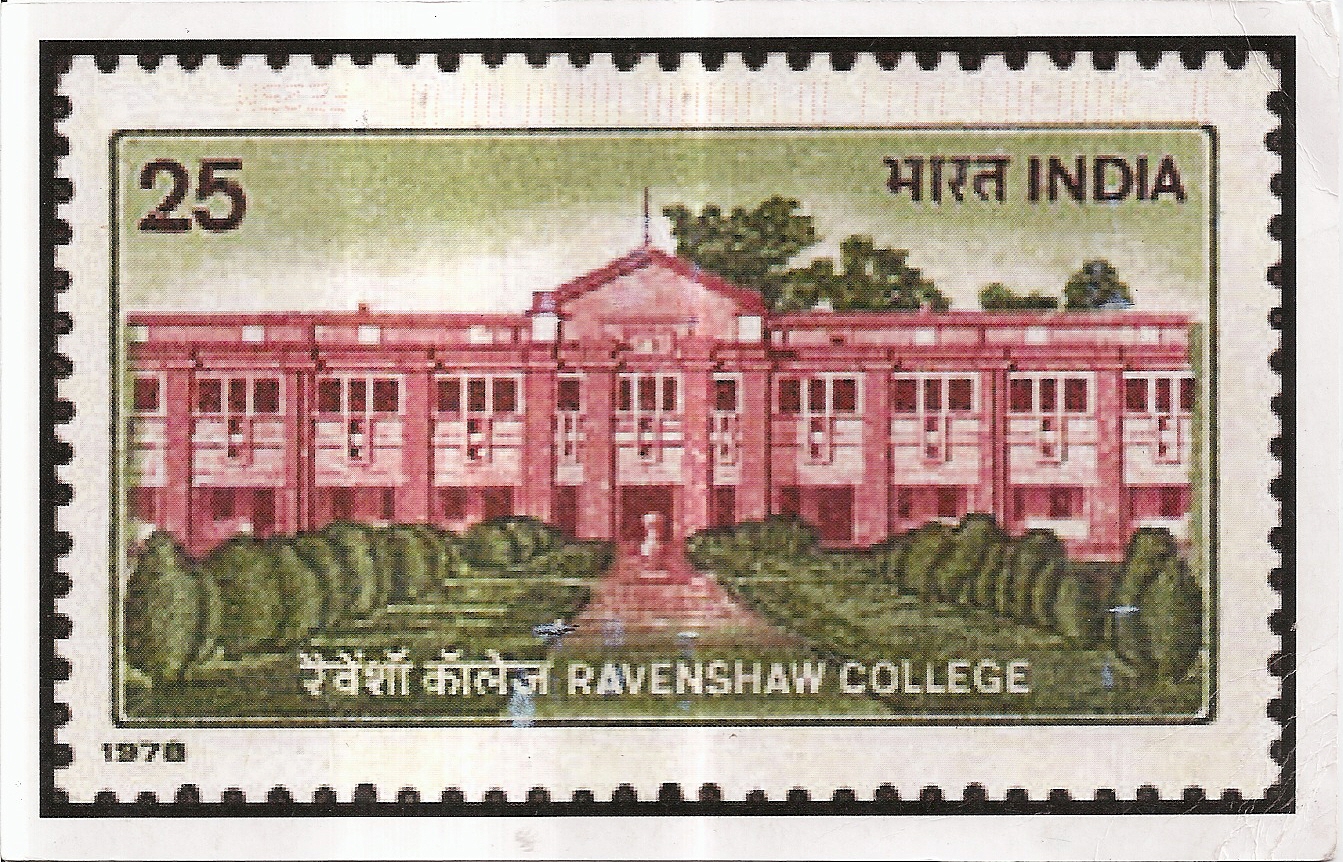
When the College completed 100 years in 1978, a commemorative postage stamp was issued by Government of India. I was lucky to have attended the Centenary Celebrations of the College that year.

At the centre of the spacious college-quadrangle, surrounded by class rooms, there is a sundial. Below the top, there is a circle with lines. The shadow of dial moves on these lines as the sun moves overhead and with this, one can tell the time of the day.


The Sun Dial


Postage Stamp on Ravenshaw College issued in 1978
The College was accorded Autonomous status in 1989 and became a unitary university in 2006.

It is housed in a magnificent red brick building of Gothic architecture which is landmark of Cuttack. The other red brick building which stands out in Cuttack is the seat of Orissa High Court established in 1948.

Ravenshaw has acquired a distinctive, cosmopolitan culture of its own. The College motto is ‘Gyanameba Shakti’ or 'Knowledge is Strength'.


       The Emblem

The emblem of Ravenshaw has three segments, separated by a river and its tributaries. The microscope on left symbolizes the insatiable human spirit of inquiry and scientific research fostered by this institution. The palm leaf manuscripts on a stand with writing instrument on the right, represent the great storehouse of accumulated wisdom of past generations and the pursuit of creativity which are the hallmarks of this institution. The open book at the bottom epitomizes dissemination of knowledge and wisdom which the college inculcates. The river and its tributaries suggest the endless flow of knowledge through great stretches of time and the perennial flow of life, its unity and diversity.


I have preserved, as a memorabilia, the College Identity Card issued to me.


My College Identity Card


Soon after i joined the College, there was a strike by the students over an incident. Soon, it spread all over the State and there was police-firing. Due to this, classes could not be conducted for a long period. The strike ended after Guljari Lal Nanda, the then Union Home Minister, came to the College and addressed the students. A tragic offshoot of the strike was the suicide of a brilliant student Loknath Acharya, who was probably the General Secretary of the Students’ Union. There is a stipulation that to be eligible for appearing at the University Examination, a student has to attend not less than 75% of the total number of classes conducted. Due to the strike, most of the students failed to fulfill this condition. So, when the College started functioning normally, there was a series of classes for a few minutes each, where only attendance was taken. This was to ensure that the students would be able to satisfy the condition about the percentage of attendance. Most probably, Loknath Acharya could not meet this condition even after the extra classes. As a brilliant student, he had planned an outstanding career. Since he could not appear at the University Examination, his high hopes were dashed and in a fit of depression, he jumped before an approaching train near the Cuttack Railway Station.  

For a long time, the most renowned and senior-most Professor of the State was being appointed as the Principal of Ravenshaw College. He used to go on to become the Director of Public Instructions, Odisha and then the Vice-Chancellor of Utkal University to which all the Colleges of the State were affiliated. In 1967, when two more Universities were formed in the State, this practice of selecting Vice Chancellors started being diluted.

At the time of my starting college-education, the first year was called ‘Pre-University’; this was followed by what was being called ‘First Year Degree Course’. Students were required to appear at an Examination conducted by the University at the end of each of these 2 years. This was followed by a 2-year Course leading to Graduation. The school-education was up to Class XI ending with High School Certificate Examination. This system has since been modified to 10+2+3 course and school-education is up to Class X, ending with Secondary Examination. This is followed by Higher Secondary education at Junior Colleges, popularly but mistakenly called +2 Course. Graduation is a 3-year Course at a College. Again, this is mistakenly called +3 Course! (What plus 3?)

The magazine of Ravenshaw College (University) is named Ravenshavian. When i was a student there, two articles written by me were published in it. I had received the 3rd prize in Odia Short Story Competition at the College-level. I had also received the first prizes in Odia Short Story and English Essay Competitions in my hostel.

 
My elder brother, my wife and our daughter were all students of this precious College of mine. To top it all, after completing my post-graduation, i taught at this College for about 20 months as a Lecturer in Political Science. Then i joined a bank.

One intermittent demand heard in Odisha is that the name of Ravenshaw University should be changed and that ‘Ravenshaw’ should be replaced by the name of some eminent person of the State or of the rest of India. The ineptitude and callousness of the Administration headed by Ravenshaw had resulted in the death of over 10 lakh persons in the famine of 1866. For this, he had faced criticism even by the British Government. After independence, the name of Victoria School, Cuttack, was changed to Bhaktamadhu Vidyapith after the name of Bhaktakabi Madhusudan Rao. However, many oppose this saying that any change in its name will result in loss of the reputation and familiarity built over a long period. Those opposing the change also affirm that around the time Ravenshaw College was established, a few other reputed educational institutions
like Elphinsten College of Mumbai (then Bombay), St. Stephens College of Delhi and Bethun College of Kolkata (then Calcutta) also came into being. Over the years, all these have built up high reputation for excellence. No one has ever thought of changing their names, to preserve their antiquity and intellectual reputation. 


TAIL PIECE:
   
I have a sentimental link with this great institution due to another reason. (I feel the Tail Piece of my post ‘Those Hard Days…..’ is worth repeating here.)
My future wife was a student of this College and was 3 years my junior. She got admitted to the College when i was in the Final Year of my Degree Course. After our marriage, once, when she was in an expansive mood, the wife confided to me that during her first year in the College, a thought passed her mind that her future husband must be studying in this famous College! What a self-fulfilling thought! We did not know each other then but might have had seen each other (not met!) without having an inkling about what God and fate were brewing for us!!! 

 
Posted by The Gardener at 09:43 No comments:
Labels: Heritage, Life
Newer Posts Older Posts Home
Subscribe to: Comments (Atom)


About Me

My photo
The Gardener
I am a retired banker, now turned into a full-time gardener. :)
View my complete profile

Blog Archive

  • ▼  2019 (1)
    • ▼  September (1)
      • Didi II - A Family-Name Extinguished
  • ►  2017 (16)
    • ►  November (4)
    • ►  September (2)
    • ►  July (1)
    • ►  May (1)
    • ►  April (2)
    • ►  March (1)
    • ►  February (1)
    • ►  January (4)
  • ►  2016 (20)
    • ►  December (2)
    • ►  November (1)
    • ►  October (1)
    • ►  September (3)
    • ►  August (2)
    • ►  June (3)
    • ►  May (3)
    • ►  April (3)
    • ►  March (2)
  • ►  2015 (17)
    • ►  December (1)
    • ►  October (1)
    • ►  August (1)
    • ►  July (1)
    • ►  June (1)
    • ►  May (2)
    • ►  April (2)
    • ►  March (4)
    • ►  February (1)
    • ►  January (3)
  • ►  2014 (22)
    • ►  December (5)
    • ►  September (3)
    • ►  August (3)
    • ►  July (1)
    • ►  June (1)
    • ►  May (1)
    • ►  April (1)
    • ►  March (3)
    • ►  January (4)
  • ►  2013 (29)
    • ►  December (2)
    • ►  November (3)
    • ►  October (1)
    • ►  September (2)
    • ►  August (4)
    • ►  July (4)
    • ►  June (2)
    • ►  May (1)
    • ►  April (1)
    • ►  March (2)
    • ►  February (3)
    • ►  January (4)
  • ►  2012 (47)
    • ►  December (3)
    • ►  November (3)
    • ►  October (4)
    • ►  September (6)
    • ►  August (5)
    • ►  July (4)
    • ►  June (4)
    • ►  May (2)
    • ►  April (4)
    • ►  March (5)
    • ►  February (2)
    • ►  January (5)
  • ►  2011 (36)
    • ►  November (2)
    • ►  October (3)
    • ►  September (5)
    • ►  August (5)
    • ►  June (1)
    • ►  May (3)
    • ►  April (6)
    • ►  March (2)
    • ►  February (5)
    • ►  January (4)
  • ►  2010 (14)
    • ►  December (1)
    • ►  November (3)
    • ►  October (8)
    • ►  May (2)

Followers