Friday, 20 July 2012

Good Faith III - Doing Wrong and Going Wrong

This happened when I was working at Kolkata. I was appointed as the Inquiry Authority in the case of Charges against a Manager. A Credit Facility was sanctioned for a borrower against the security of landed property belonging to the guarantor. This Manager had been entrusted with the duty of inspecting the property to verify its genuineness. The Account became bad and when the Bank initiated steps for enforcing the security, it came to light that the Bank had been defrauded. The property belonged to a person who had long been dead, much before sanction of the facility.

As per the Bank’s guidelines, inspection of such property has to be conducted independently, i.e., without the involvement of the borrower or the guarantor, basing on the address and other details of the property submitted to the Bank. This Manager had asked the guarantor, the so-called owner of the property, to take him and show the property.

Now, coming to practicality, in most cases, Bank Officers in good faith do take the help of the borrower or the guarantor to locate and inspect the property offered as security. However, in case any thing goes wrong, the Officer cannot take the plea that she/he had inspected the property shown by the borrower/guarantor.

The Inquiry System of the Bank is like this. Whenever any thing goes wrong, an Investigating Officer goes into the transaction, inspects the securities, obtains Statements from the concerned persons and submits a Report. If from this Report, it is found that any employee of the Bank was negligent in following the Guidelines, or was otherwise involved, this employee is issued a Charge Sheet. The Bank appoints a Senior Officer as the Inquiry Authority to go into the matter. A Presenting Officer (P O) is designated to present the Bank’s case. The Charge Sheeted Employee/Officer nominates a Defence Representative. The Inquiry process is somewhat similar to the judicial process. The P O presents the Bank’s case, submits the relevant documents (Management Exhibits) and produces Management Witnesses. They are cross-examined by the Defence Representative (D R). The D R submits documents in support (Defence Exhibits) and produces Defence Witnesses. After hearing both the sides, the Inquiry Authority submits his Findings. He has to say unambiguously whether he finds the employee/officer ‘guilty’ or ‘not guilty’.

In this case, I found that the Charge Sheeted Manager was a sincere Officer but since he had not made an independent inspection of the property he was ‘guilty’ as per the Bank’s norms.

Here, an unwritten law regarding the quantum of punishment is followed in Banks. A distinction is made between “Doing Wrong’ and ‘Going Wrong’. If the Charge Sheeted employee/officer is found to have deliberately done something wrong or has clearly been negligent, there is no escape for him but if has taken due care but has gone wrong in his judgement , only a minor punishment is imposed. Keeping this in mind, although I had no choice but to find him guilty, I diluted the matter by highlighting how he had no intention of doing anything wrong but had had gone wrong by over-trusting the borrower and the guarantor.

A minor punishment was imposed on him. And I felt very happy when two years later, he got a promotion.

The situation is not always so bright. People have violated norms to bring in good business and have been rewarded with good placements and promotions. But there have also been cases where sincere, hardworking and well-meaning employees/officers have suffered for believing customers and ignoring guidelines, all in the interest of increasing the Bank’s business.

They have been offered only tea and sympathy.

Sunday, 15 July 2012

Brahma Kamal

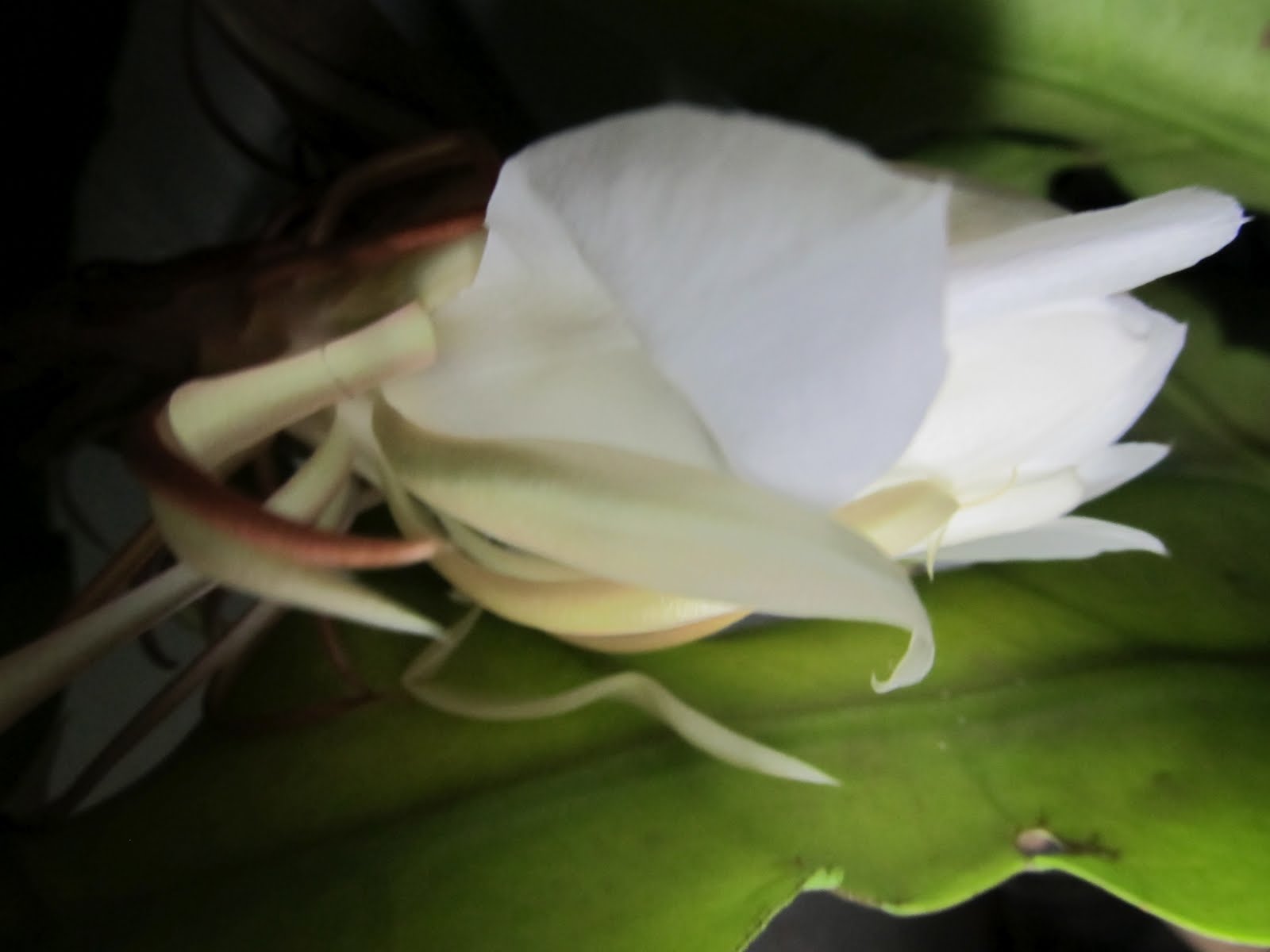
Here are the different stages of Brahmakamal flower which bloomed in my garden in the evening of the 9th July, 2012.

1. About a week before

Blooming....blooming !!!
2. 4 P M


3. 6 P M


4. 6.30 P M


5. 8 P M


6. 8.30 P M

BLOOMED !!!!!
7. 9 P M


8 9.30 P M


9. 10 P M


IT'S ALL OVER :((( 10. 5 A M the day after


Brahmakamal is a plant which thrives in The Himalayas. Botanists have identified 31 varieties of Brahmakamal in the Himalayan range. It blooms only once in a year during July-September. The flowers bloom at night and remains for one night. It starts blooming late in the evening, opens up fully between 10 P M and 11 PM. and starts closing down after midnight. It withers away before dawn the next day. The flowers have a lovely fragrance.
It looks like lotus but is of smaller size.
Legend has it that Brahma emerged from navel in a lotus flower. Hence the name Brahmakamal.
It is believed that Brahmakamal does not bloom in all homes. So people consider themselves lucky and blessed if they are able to witness this rare event and perform puja at the time of its blooming. Blooming of Brahmakamal is considered a good omen. There is a belief that Brahmakamal plant should be received as gift and not bought. (I received it from a friend.) To grow the plant, a mature leaf of an existing plant is planted in the soil. The plant has almost no stem. The base of leaf which is planted becomes hard and transforms itself into a small stem. The flowers bloom from the sides of leaves.
Brahmakamal finds a place both in Ramayana and Mahabharat. In Ramayan, when Laxman was revived with the help of Sanjibani, Gods in celebration showered flowers including Brahmakamal which took root in Earth. In Mahabharat, Bhim was going up to the jungle in search of Brahmakamal when he met Hanuman disguised as an old monkey sitting on the way.
Brahmakamal is the official ‘State Flower’ of Uttaranchal State in India. A postage stamp on Brahmakamal was released by Post & Telegraph Department, Govt. of India in 1982.
ADDENDUM:
The Brahmakamal bloomed in my garden in the same evening when the wife returned from Singapore after visiting Daughter II.
BY THE WAY:
Why is ‘h’ place before ‘m’ while writing ‘Brahmakamal? While pronouncing the word, the sound of ‘m’ comes before that of ‘h’.
2. Why have lovely things a short span of life?

Here is a video of Brahma Kamal blooming (Source: You Tube) 


And one more:

Thursday, 5 July 2012

Good Faith II - Second Time Lucky

In the first installment of this series, I have narrated how bankers are forced to ignore laid down guidelines to secure or retain good business or fearing loss of business.

Here is an incident wherein I trusted the customer and overlooked the established norms fearing that if I do not comply with his request, the customer would go to some other bank. This happened in a Capital-city of a State.

It was a very valued Account of the Branch and Bank Guarantee Limit of Rs. 30 Lakh had been sanctioned. One of the conditions of the sanction was that the customer would provide landed property worth about Rs. 50 Lakh as security. The firm was earlier enjoying a Bank Guarantee Limit of Rs 20 lakh and landed property valued Rs. 30 Lakh had been given as security. The customer was to hand over to us the title deeds of landed property worth Rs. 20 Lakh to make the total value of security Rs. 50 Lakh.

This Bank Guarantee was to be given to Railway Authorities in lieu of security-deposit for an work-order which the customer was awarded by Railways. A Bank Guarantee is a guarantee issued on behalf of a customer under which a bank has to pay the amount to the beneficiary (here the Railways) whenever the latter demands, without any question.

The customer came and told me that the documents relating to the additional property to be given as security was with his brother who was out of the city and would return after three days but he needed the Bank Guarantee the next day itself. He promised to handover the documents after 3 days when his brother would return. Earlier we had agreed to a similar request from him and he had kept his word. Taking into account the creditworthiness and dependability of the customer, I agreed. The Bank Guarantee was issued before receipt of security, as requested by him.

However, this time he did not keep his promise and the documents were not handed over even a week after the promised day. The Officer who along with me had signed the Bank Guarantee became panicky. I became very worried. The customer went on promising but did not do anything for full 10 days. He did not take my calls and avoided me in person. I went on praying to God to save us. I could not concentrate on anything and my sleep became disturbed.

Then one fine day the customer came to the Bank, surrendered the Bank Guarantee and requested us to cancel it. I did not ask anything, quietly and quickly cancelled the Bank Guarantee and heaved a sigh of relief. After that I asked him what had happened. He informed me that he had gone to another Bank and had got a Bank Guarantee for Rs. 75 Lakh. Originally, he had applied to us for a Bank Guarantee of Rs. 75 Lakh but the Controlling Authorities of my Bank had sanctioned only Rs. 30 Lakh.

We lost the Account and the business of this firm. The firm went to the other bank, for preventing which I had put so much at risk.

Here is another story of ‘due negligence’ by a banker to protect the goodwill and creditworthiness of a valuable customer. It was place in Bihar. I was the Chief Manager of the branch and the second-in-command was a Senior Manager. I was away. A cheque for Rs. 50000 drawn by this customer was presented. The balance in his account was very low. Usually he used to maintain good balance in his Account and no cheque issued by him was ever returned. The Senior Manager tried to contact the customer but could not do so. Returning the cheque would damage the reputation of the customer. So what did the good Senior Manager do? He debited the cheque to another customer’s Account, where there was sufficient balance “by mistake”! He could contact the first customer on the next day and told him what he had done the previous day. The customer thanked the S M profusely and immediately deposited sufficient amount to meet the cheque. Thereafter, the S M “corrected the mistake” and credited the amount back to the second customer’s Account. He then contacted the second customer and explained that a ‘mistake’ had been committed and ‘promptly’ rectified!!!

When I rejoined after two days, the S M explained to me the entire episode. I did not know whether to thank and congratulate him or to caution him against such dare devilry in future. I did both.

The Branch was rewarded by the grateful customer, who passed on further handsome business to us.

What would happened had the customer not deposited the amount or if he would have done so after a time gap? How would we have faced the second customer?

Such is the saga of good faith and ‘due negligence’ of bankers, all for improvement of business.

PROMISE:

Wait for more such real life stories!

Monday, 2 July 2012

In Good Faith, With 'Due' negligence

For a Banker like me, The Negotiable Instruments Act, 1881, is the Gita to which all bankers in India have to refer on all occasions. Section 10 of this Act defines ‘Payment in Due Course' as ‘payment in accordance with the apparent tenor of the instrument in good faith and without negligence to any person in possession thereof under circumstances which do not afford a reasonable ground for believing that he is not entitled to receive payment of the amount therin mentioned’.

The two key terms in any Banking transaction are ‘Good Faith’ and ‘Without Negligence’. However, no situation in a Banker’s life is ever perfect or ideal so that s/he can strictly abide by these two acid tests . Doing things in good faith is alright but sometimes, to garner business, to ‘help’ a customer, or fearing loss of good business, bankers sometimes have to dilute the other term ‘Without Negligence.’ In such situations, a banker follows what in lighter banking parlance is called ‘With Due Negligence’.

For example, it is a fact that no two signatures of the same person are identical in all features. There is always a slight variation. So while paying a cheque, a practical banker has to ignore small variations in the signature of the account-holder. An unofficial axiom followed by bankers in this regard is that if a signature is perfectly identical with the Specimen Signature of a customer lodged with the bank, it is a forged one. That is because only a perfect forger can copy a signature perfectly.

Besides this, many times, for fear of losing business, a banker has to believe and trust the customer. However, many times, later on, this trust is proved to be misplaced. Believing the customer, a banker sometimes ignores or sidesteps some laid down guidelines of the Bank and lands in trouble.

I shall narrate an incident which I became involved way back in 1982. It was my first assignment as a Branch Manager. It was a small District Head Quarters Branch. The customer was a big company with its Head Quarters at Kolkata. It had a Unit and a factory in that small place. The Company was the most-valued customer of the Branch. A Bill for over Rs. 10 lakh , accompanied by Lorry Receipt was received by us through another Bank. One of the instructions of that Bank was to collect along with the principal amount, interest on the Bill amount at certain percent from a specified date till the date of actual payment. One day I received a telephone call from the Managing Director of the local Unit of the Company informing me that they would pay the Bill that day. He informed me that he had talked to the supplier of the goods and that the latter had agreed to waive the interest. He added that their letter addressed to the supplier confirming their telephonic talk about waiver of interest would take a day to prepare and he requested me to release the Bill on payment of the principal amount only. Since the goods covered by the Lorry Receipt were urgently required by them they wanted to get the Bill released that day itself. He assured me that the letter would definitely reach me the next day. He concluded assuring me not to worry at all.

When the Company’s man came to the Bank to pay the Bill without interest and take the Lorry Receipt for taking delivery of the goods, the Officer in charge of the concerned Section of my Branch came to me. I told the Officer not to worry since the M D was a big man and that he would not let us down. The Officer had his misgivings and so I authorized receiving the Bill amount without interest.

The letter from the Company did not come the following day. So I telephoned to the M D about it and he said that the letter was being prepared. “It will be on your table this afternoon or latest by tomorrow morning.”, he said.

The letter did not come on the promised day.

After following up for a week, I received the copy of the Company’s letter to the supplier. On reading it I felt as if the ground had slipped from underneath my feet. Instead of confirming the so-called consent for waiving the interest, the letter listed a large number of allegations against the supplier and ended with, “In view of the foregoing, we are not paying the interest.”

I tried to speak to the M D but his people said that he was busy. I tried to meet him but his people said that he was busy in a meeting which would go on till late in night.

A week after that, I received a letter from the authorities of my Bank asking me to explain why the interest amount of about Rs. 95,000.00 (And this was 30 years ago!) was not collected. The supplier’s Bank had complained to my Bank’s Head Office.

After numerous efforts, I could meet the M D and showed him the letter from my Bank regarding the Bill. He smiled nonchalantly and said, “Don’t worry; you can leave your Bank and join our Company.”

It was my good luck that the M D was shifted soon thereafter and a new person took over. The new M D arranged for payment of the interest-amount.

So much for ‘good faith’.!!!

ADDENDUM

Daughter I and the daughter of the earlier M D were studying in the same school and same class and were close friends. They used to visit each others’ homes. Often, I used to take my daughter to her friend’s home.

Wednesday, 27 June 2012

Mangoes, Bananas and Dried Fish

I read from the Third Editorial in a recent issue of The Times of India about the harrowing experience of the contributor’s mother with the Customs officials at an airport in U S of A. (Third editorials are pieces, generally with a tinge of humour, contributed by readers.) The old lady was carrying a packet of the delicious Indian mangoes for her son. She was asked at the Customs desk if she was carrying any fruits or dairy products. The honest lady said that she was carrying a packet of mangoes. With this, alarm bells went off and she was asked to surrender the packet as it might ‘contain mysterious bacteria’. The lady retorted, “I have been consuming this ‘mysterious bacteria’ for years and am still alive!” This did not cut any ice with the official. So she asked him whether he had a knife. The official was bewildered (and probably alarmed too). The good lady explained that with knife she could cut one of the mangoes and he could taste the heavenly fruit. This fell flat on the law-enforcing official and she had to surrender the packet almost tearfully, thinking about her beloved son being deprived of the pleasure.

This reminded me of a not-so-similar experience of mine when the wife and I had gone to visit Daughter I living in U S A. I had carried a small packet of exotic bananas from my garden. I had lovingly grown the plant and it had borne fruits for the first time. The bunch was still green and I reckoned that the fruits would ripen a few days after our arrival there. It would be in the fitness of things that the first yield would be enjoyed by our first child. Deliberately but with a lot of trepidation, I did not declare it. My heart was pounding when I passed through the Immigration desk. To my good luck, everything went off well and I landed at Daughter’s house with the bananas. :)))))))))))))))))))) I have vowed not to repeat any such act, if only to avoid a pounding heart. :(((((((((

Why are seeds, fruits and vegetables not allowed? This takes me to the wicked Parthenium weed which came to India riding on the back of wheat-grains imported by India in the 1950s to meet a huge food shortage.

Parthenium hysterophorus is a weed that came to India along with the PL 480 US wheat seeds in the 1950s and 1960s. At that time there was a big shortage of food grains and India imported wheat under Public Loan 480 plan under Food For Peace Programme of USA. The weed grew into uncontrollable proportions invading million of hectares of uncultivated wastelands, roadsides, railway tracks, etc. One plant of Parthenium can produce around 25000 to 30,000 seeds that can propagate rapidly with wind. The fast growing weed has spread all over India and is a nuisance in public parks, residential colonies and orchards. It causes health hazards such as skin allergy, hay fever and asthma in human beings and is toxic to livestock. It squeezes grasslands and pastures, reducing the fodder supply. Scientists describe it as a poisonous, allergic and aggressive weed posing a serious threat to human beings and livestock. Its seeds became a menace in the wheat fields of Punjab, Haryana and Uttar Pradesh.
.
The deadly weed came to be named ‘Congress grass’ because it was imported into the country by the then Congress government in the Centre. It is also known as ‘Carrot grass’. In Hindi it is called gajar ghas.

This mother’s story takes me down memory lane. I was working in UP. Daughter I was on the way, and the wife was craving dried fish (which I abhor). My mother came to know about it. One day, at my bank, I received a Registered Post parcel. Curious to know what my mother had sent, I opened the packet. Removal of the packing wrappers revealed a tightly sealed small tin container. My curiosity was in full hold of me. With a lot of difficulty, I opened the cover. And out came the smell of the dried fish. Before it could spread and reach my colleagues, I quickly closed the tin tightly and put it inside my drawer. However, a little of the smell had come out and one of my colleagues remarked, “Something is smelling.” I kept quiet and thankfully after a little while the smell disappeared. Mothers will be mothers!

I read somewhere that in the 17th Century one Sufi Saint Baba Budan smuggled just seven coffee beans from Mecca into the Kingdom of Mysore. He planted those seeds and that was beginning of coffee-plantation and production in India!

TAIL PIECE

Why do I say ‘the wife’? A friend of mine who reads my blog posts asked me this. Years ago, when I was still working, I had contributed a humorous article to my Bank’s House Magazine. In that, I had used the term ‘the wife’. The editor in his wisdom, changed it to ‘my wife’. I can say ‘Daughter I’ and ‘Daughter II’ but …... Need I say anything more?

Tuesday, 19 June 2012

Samakaala

Odisha Sangeet Natak Akademi organized a Festival of Contemporary Dances named ‘Samakaala’ from the 11th to the 13th May, 2012 and I had the good fortune of attending it.

Bharat Sharma’s Bhoomika Creative Dance Centre, New Delhi and Ananda Shankar Jayant’s Shankar Kalaakshetra, Chennai presented beautiful dance numbers on the first day.

Sharma’s first presentation called ‘Hans Balaka’ , based on Rabindranath Tagore’s poem, represented the winter-migration of birds from Siberia to various parts of India. His second presentation called ‘Street Boys’ showed the uninihibited spirit of youth. The third presentation called ‘Rangabali’, presenting the three colours and the chakra of the Indian National Flag, was a well-choreographed number. The dance-movements revolved around imagined characteristics of each colour and the centrality of the chakra in the flag’s formation. The Group’s last presentation was ‘Jatak Mala’ based on the evolutionary cycles of the Buddha’s previous lives.

Dr. Ananda Shankar Jayanta’s dance-presentations lead her audience on a spiritual and ethereal journey. Her presentation in the evening was ‘Dancing Tales – Panchatantra’. This five-part presentation was based on the legendary Bishnu Sharma’s epic tales Panchatantra, which through fables and allegory, talks about friendship, bravery, foolishness, leadership and freedom.

In the second evening, Madhu Nataraj and her troupe from Natya Stem Dance Kampani of Bengaluru presented ‘Vajra’, as ‘the diamond, lightening and a weapon, connecting the qualities of indestructibility, Shakti, brilliance, unbridled power and enlightenment’.

The second presentation of that evening was ‘Amritasya Putra’ by Kolkata’s Mamata Shankar, daughter of Uday and Amla Shankar. It showed ‘how we all are a spark of that divinity born of the 5 divine elements, Fire, Space, Wind, Earth and Water and how the soul moves in various forms in the cosmic world before entering the human body. The very first emotional experience we have in our life is that of Love, mother’s self-less, untainted and ever caring love. The second stage of Love is that of a friend, having no gender barriers, pure, innocent and sparkling with happiness. The third stage of Love is the awareness of love between a man and a woman, like a flower’s longing for the sun and the rain, sacred and pure. Then gradually, ignorance and delusion creep in, and moves us away from our own true self. The same love, which so far was divine, innocent and pure, changes into lust, greed, desire and ego breeding hatred, jealousy, anger and violence. At the end, we are left with pain, suffering and sorrow. It is then, out of repentance, that our inner search begins for the ultimate truth, and someday, we realize that we are all a spark of that Divinity, we are all Amritasya Putra.’ It was a brilliant performance.

The first presentation of the third evening was ‘The Child’ by Tanushree Shankar and her troupe from Kolkata. ‘The Child’ is the only the only poem of Rabindranath Tagore written originally in English. The dance number presented how ‘man’s journey from the darkness of ignorance, hopelessness and desperation of life, to the light of knowledge and understanding, is difficult, full of turmoil, doubt and treachery. It is fragile hope and faith that takes him along. Even that faith seems inadequate to the rigours of this journey. Yet, this faith carries him through to enlightenment and the newness of life represented by the child, full of innocence, simplicity and potential. Tanushree’s interpretation depicts a flowing rhythmic, spiritual journey of Man through ages, from the bondage of ignorance, ultimately to the freedom of enlightenment and self-realisation.

The last presentation of the 3-day Festival was ’White’ by Ronnie Shambik Ghosh and Mitul Sengupta. ‘Life is an odyssey, a canvas of various emotions captured in numerous fragments in time. It unfolds in phases, beginning with neutrality, and then follows up with a surge of emotions, anecdotes and imagination. We view life as WHITE – a colour epitomizing truth, purity and enigma. It is an amalgamation of all the hues in our life, which is a blend of myriad moments, united together to become one entity in one’s life time. WHITE can also be interpreted as an ocean, as do emotions and moments in life’

It was my first exposure to contemporary dance and I was looking forward to attend the Festival, particularly to the presentations of the internationally famous danseuses like Mamata and Tanushree Shankar, both trained by Amla Shankar. I love to watch classical dance forms like Bharatanatyam, Odishi, Kathak, Kuchipudi, Mohiniatam, Kathakali and Manipuri. I was looking forward to attend and did enjoy the dance numbers presented during this Festival but some intricacies and nuances of the contemporary dance forms were incomprehensible to me. In the narrative, I have mostly used the words of the booklet which was provided to the viewers at the Festival.

Of course, I do not mean to say all the dance numbers were incomprehensible; a few portions were so.

As I, an ordinary viewer, see it, in classical dance forms, the intricate nuances of the dance are brought out mostly through expressions of the face, particularly the expressive eyes which speak. This is supplemented by the movement of the hands, particularly the fingers, and the other parts of the body. Mudras (intricate hand gestures), bhabhas (facial expressions) and deft foot-work play important roles. The music provides the back ground. In modern dance forms, light, sound and other technology and props play a vital role. These complement and supplement the skill of the artist. The viewer also has to transport herself/himself to a higher level of imagination above and away from mundane life. The viewer has to be a participant to appreciate this art form.

That evening also reminded me of modern poetry and modern art.

Sometime ago, I read in a newspaper, the interview of a literary figure well-known for her modern poetry. She was asked why it was that many modern poems were difficult for the common educated people to understand. She replied by way of an example. If you are to understand Tamil, you must know Tamil language, she said.

This takes me to the reply of a painter of modern art. A friend of his, a ‘commoner’ asked him why the faces of human beings in his works of art did not look like real faces. The artist took out a photograph of a person and asked, “Should a piece of art be like this? Is this photo exactly like the person it represents? No, it is rather flat.” Perhaps the artist meant that the photo had only length and breadth and did not have the third dimension which a real person had.

Whenever I come across modern poetry, I read it and try to comprehend it but most of the time it goes over my head. I regularly visit art galleries whenever there is a painting exhibition but as far as modern art is concerned, I am an ignoramus

Thursday, 14 June 2012

The Lily Family

1

2

3

4

5

The fourth photo is that of the football lily and the the fifth one is the plant of the football lily. The wilting and drooping flower can be seen near the stem of the plant.The plant sprouts up from underground soon after the first rain towards the end of summer. The flower wilts after its life is over. After the rainy season, the plant disappears into the ground. The flower emerges soon after the first rain in May. Perhaps that is why it is called Bhuin Padma (literally Lotus on Land) in Odia. It is followed by the appearance of the plant and the cycle goes on.

I have another plant of the lily family. It is of deep pink colour and is of small size. It blooms during rainy season. Here it is:

.

There is yet another member of the lily family in my garden: